How Much Does Press Brake Tooling Cost?
Comprehensive cost analysis including initial investment, operational costs, and total cost of ownership for different tooling types and materials.
How Much Does Press Brake Tooling Cost?
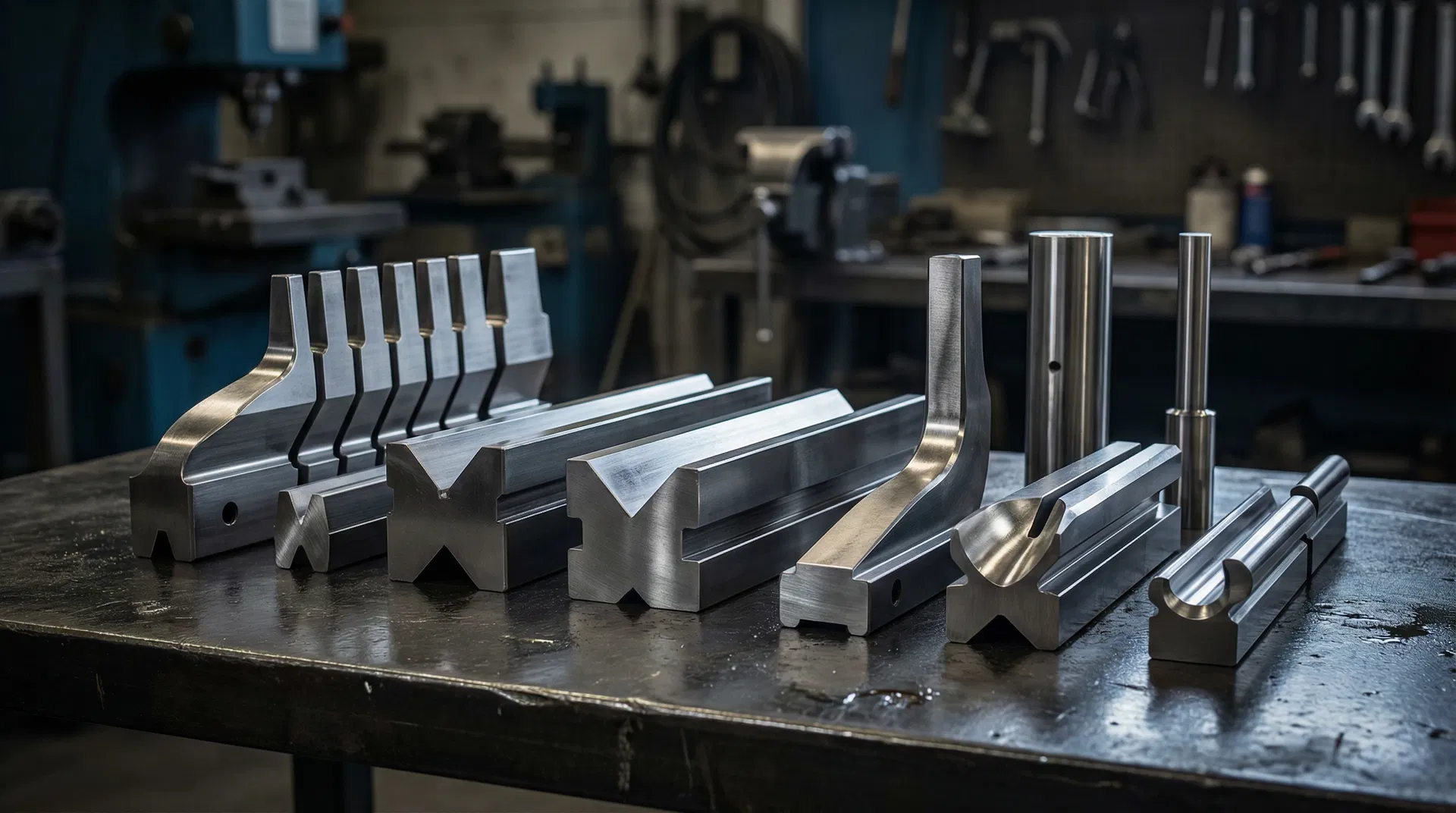
Press brake tooling represents a significant capital investment with ongoing operational costs. Understanding the complete cost structure—initial acquisition, maintenance, replacement, and total cost of ownership—enables informed budgeting and procurement decisions that optimize both quality and cost efficiency.
Initial Tooling Costs
Standard Tooling Pricing
Basic Tool Steel (42CrMo4, 58-60 HRC)
Punches (per 835mm section):
- Standard 85° punch: $200-400
- Acute angle punch (30-60°): $250-500
- Radius punch: $300-600
- Gooseneck punch: $400-800
Dies (per 835mm section):
- Standard V-die (single V): $300-600
- Multi-V die: $500-900
- Precision ground die: $600-1,200
Complete basic tool set (punch + die, 835mm): $500-1,000
Premium Tool Steel (D2, 60-62 HRC)
Punches: $350-700 (+75% vs. basic) Dies: $500-1,000 (+65% vs. basic) Complete set: $850-1,700
The premium pricing reflects superior material, tighter tolerances, and enhanced heat treatment for extended service life.
Treated and Coated Tooling
Nitrided Tooling Premium over untreated: +30-50% Typical pricing: $650-1,500 per set Service life: 2-4× standard tooling
Nitriding creates a hard surface layer (65-70 HRC) while maintaining core toughness, ideal for high-strength steels and high-volume operations.
Coated Tooling (TiN, TiCN, CrN) Premium over untreated: +40-60% Typical pricing: $700-1,600 per set Service life: 3-5× standard tooling
Coatings provide excellent wear resistance and reduced friction, particularly effective for stainless steel and abrasive materials.
Chrome Plated (for aluminum) Premium over untreated: +25-40% Typical pricing: $625-1,400 per set Prevents galling with aluminum and soft materials
Custom Tooling Pricing
Custom tooling costs vary significantly with complexity:
Simple Modifications
- Non-standard length: +$50-200
- Special angle: +$100-300
- Custom radius: +$150-400
Complex Custom Designs
- Special profiles: $1,500-5,000 per set
- Integrated features (pins, sensors): $2,000-8,000
- Hemming tools: $3,000-12,000
- Multi-stage forming tools: $5,000-20,000
Custom tooling requires engineering design, specialized machining, and often multiple iterations. Lead times extend to 8-16 weeks for complex designs.
Quick-Change Systems
Manual Quick-Change Tooling premium: +30-50% over standard clamping Complete system (rails + adapters): $3,000-8,000 Tool holders: $150-400 per section
Hydraulic Quick-Change Tooling premium: +50-80% over standard clamping Complete system: $15,000-40,000 Tool holders: $300-800 per section
Quick-change systems require significant upfront investment but reduce setup time from 30-60 minutes to under 5 minutes, valuable for high-mix operations.
Length and Segmentation
Length Pricing
Tooling cost scales with length but not linearly:
Standard Segments (835mm) Base price: $500-1,000 per set
Custom Lengths
- 300mm: $400-800 (80% of standard price)
- 500mm: $450-900 (90% of standard price)
- 1000mm: $600-1,200 (120% of standard price)
- 2000mm: $1,400-2,800 (280% of standard price)
Long tools (>1500mm) incur disproportionate costs due to material requirements, machining complexity, and deflection control.
Segmentation Strategy
Example: 3000mm Bend Length
Option 1: Single 3000mm tool Cost: $2,200-4,400 Advantages: Continuous surface, no alignment issues Disadvantages: Difficult handling, storage challenges, deflection risk
Option 2: Four 835mm segments Cost: 4 × $600 = $2,400 (4 × $500-1,000) Advantages: Flexible configuration, easier handling Disadvantages: Alignment required, potential marking at joints
Option 3: Optimized segmentation (1000mm + 1000mm + 1000mm) Cost: 3 × $700 = $2,100 Advantages: Balance of flexibility and continuous surface Disadvantages: Moderate complexity
For most applications, 500-1000mm segments optimize cost, handling, and performance.
Machine Standard Compatibility
European Standards
Promecam Most common European standard Tooling availability: Excellent Pricing: Standard (baseline)
Wila Quick-change system integrated Tooling availability: Good Pricing: +20-30% vs. Promecam
Beyeler Swiss precision standard Tooling availability: Moderate Pricing: +15-25% vs. Promecam
American Standards
American Standard Common in North America Tooling availability: Excellent Pricing: Similar to Promecam
Precision Ground Higher precision variant Tooling availability: Good Pricing: +30-50% vs. American Standard
Adapters and Compatibility
Adapters enable using one standard on machines designed for another:
- Adapter cost: $200-600 per section
- Height penalty: 20-40mm (reduces available stroke)
- Alignment challenges
Native tooling for your machine standard is always preferable to adapted tooling.
Operational Costs
Maintenance and Cleaning
Routine Maintenance
- Cleaning supplies: $200-500/year
- Lubrication: $100-300/year
- Storage systems: $500-2,000 (one-time)
Inspection Equipment
- Radius gauges: $100-300
- Calipers and micrometers: $200-500
- Optical comparator (optional): $3,000-10,000
Regrinding and Reconditioning
Punch Regrinding Cost per regrind: $50-150 Frequency: After 100,000-300,000 bends (material dependent) Lifetime regrinds: 2-3 times
Example: $300 punch, 200,000 bends between regrinds
- Initial: $300
- First regrind (200k bends): $100
- Second regrind (400k bends): $100
- Third regrind (600k bends): $100
- Total: $600 for 800,000 bends = $0.00075/bend
Die Reconditioning Limited reconditioning options; typically replaced when worn Surface polishing: $100-300 (cosmetic only) Edge welding and remachining: $500-1,500 (rarely economical)
Replacement Frequency
Mild Steel Operations Standard tooling replacement: 12-24 months Premium tooling replacement: 24-48 months Annual replacement cost (moderate volume): $2,000-5,000
Stainless Steel Operations Standard tooling replacement: 6-12 months Treated tooling replacement: 18-36 months Annual replacement cost: $4,000-10,000
High-Mix Job Shop Diverse tooling inventory: $10,000-30,000 Annual replacement/additions: $3,000-8,000
Total Cost of Ownership Analysis
Cost Per Bend Calculation
Standard Tooling Example
Initial investment: $1,000 (punch + die set) Regrinding: 2 × $125 = $250 Total cost: $1,250 Tool life: 600,000 bends (with regrinds) Cost per bend: $1,250 / 600,000 = $0.0021
Premium Treated Tooling Example
Initial investment: $1,600 (+60%) Regrinding: 2 × $175 = $350 Total cost: $1,950 Tool life: 1,800,000 bends (3× standard) Cost per bend: $1,950 / 1,800,000 = $0.0011
Premium tooling costs 60% more but delivers 48% lower per-bend cost through extended life.
Production Volume Impact
Low Volume (50,000 bends/year) Standard tooling: $1,250 / 50,000 = $0.025/bend annual cost Premium tooling: $1,950 / 50,000 = $0.039/bend annual cost
At low volumes, tools last many years. Initial cost dominates; premium tooling doesn't pay off.
High Volume (500,000 bends/year) Standard tooling: Replaced annually, $1,250/year = $0.0025/bend Premium tooling: Lasts 3.6 years, $1,950/3.6 = $542/year = $0.0011/bend
At high volumes, premium tooling delivers significant savings through reduced replacement frequency.
Downtime Costs
Tool replacement downtime often exceeds tooling costs:
Downtime Cost Calculation
- Tool change time: 45 minutes
- Production rate: 80 parts/hour
- Lost production: 60 parts
- Part value: $25
- Downtime cost: $1,500 per tool change
Annual Downtime Impact
Standard tooling (replaced annually): $1,500/year Premium tooling (replaced every 3.6 years): $417/year Downtime savings: $1,083/year
For this scenario, downtime savings alone justify premium tooling investment, even before considering direct tooling cost savings.
Budgeting Guidelines
Initial Setup (New Press Brake)
Basic Tooling Package
- 2-3 punch sets (different angles): $1,200-2,400
- 2-3 die sets (different openings): $1,800-3,600
- Basic accessories: $500-1,000
- Total: $3,500-7,000
Comprehensive Tooling Package
- 5-6 punch sets: $2,500-4,800
- 5-6 die sets: $3,750-7,200
- Premium/treated tools for critical applications: $2,000-4,000
- Quick-change system (optional): $3,000-8,000
- Accessories and storage: $1,500-3,000
- Total: $12,750-27,000
Annual Operating Budget
Low-Volume Operation (<100,000 bends/year)
- Replacement tooling: $1,000-2,500
- Regrinding: $200-500
- Maintenance supplies: $300-500
- Total: $1,500-3,500/year
Medium-Volume Operation (100,000-500,000 bends/year)
- Replacement tooling: $3,000-6,000
- Regrinding: $500-1,200
- Maintenance supplies: $500-800
- Total: $4,000-8,000/year
High-Volume Operation (>500,000 bends/year)
- Replacement tooling: $6,000-15,000
- Regrinding: $1,200-3,000
- Maintenance supplies: $800-1,500
- Total: $8,000-19,500/year
Cost Optimization Strategies
Strategic Tooling Investment
Identify High-Volume Applications Analyze production data to identify parts/operations accounting for majority of bends. Invest in premium tooling for these applications; use standard tooling for low-volume work.
Example: 80% of bends use two tool configurations
- Premium tooling for high-volume: $3,200
- Standard tooling for variety: $2,000
- Total: $5,200 vs. $8,000 for all premium
Right-Size Tool Quality Match tool quality to application requirements:
- Prototype/development: Basic tooling
- Production <100k bends/year: Standard tooling
- Production >100k bends/year: Premium tooling
- Critical applications: Treated/coated tooling
Maintenance Optimization
Preventive Maintenance Regular cleaning and inspection extends tool life 20-30%:
- Daily cleaning: 5 minutes
- Weekly inspection: 15 minutes
- Monthly detailed inspection: 30 minutes
Time investment: ~4 hours/month Tool life extension: 20-30% ROI: 5-10× time investment
Proper Storage Climate-controlled storage prevents rust and corrosion:
- Storage system: $1,000-3,000 (one-time)
- Rust prevention: $200-400/year
- Tool life extension: 15-25%
Procurement Optimization
Volume Purchasing Negotiate volume discounts for anticipated annual requirements:
- 10-20% discount for $10,000+ annual commitment
- 15-25% discount for $25,000+ annual commitment
Manufacturer Direct Sourcing For high-volume operations, direct manufacturer sourcing saves 20-30%:
- Distributor pricing: $1,000 per set
- Manufacturer direct: $700-800 per set
- Annual savings (20 sets): $4,000-6,000
Trade-off: Longer lead times (4-6 weeks vs. 1-3 days)
Return on Investment Analysis
Premium Tooling ROI
Scenario: High-Volume Stainless Steel Operation
Standard tooling:
- Cost: $1,000
- Life: 80,000 bends
- Annual replacement (400k bends): 5 sets = $5,000
- Downtime: 5 changes × $1,500 = $7,500
- Total annual cost: $12,500
Premium treated tooling:
- Cost: $1,600
- Life: 320,000 bends
- Annual replacement: 1.25 sets = $2,000
- Downtime: 1.25 changes × $1,500 = $1,875
- Total annual cost: $3,875
Annual savings: $8,625 Additional investment: $600 (initial premium) Payback period: <1 month 5-year savings: $43,125
Quick-Change System ROI
Scenario: High-Mix Job Shop
Without quick-change:
- Tool changes: 200/year
- Time per change: 45 minutes
- Labor cost: $60/hour
- Annual labor cost: 200 × 0.75 × $60 = $9,000
- Downtime cost: 200 × $500 = $100,000
With quick-change:
- System cost: $20,000
- Tool premium: $5,000
- Tool changes: 200/year
- Time per change: 5 minutes
- Annual labor cost: 200 × 0.083 × $60 = $1,000
- Downtime cost: 200 × $50 = $10,000
Annual savings: $97,000 Investment: $25,000 Payback period: 3 months
Conclusion
Press brake tooling costs range from $500 for basic standard tools to $20,000+ for complex custom tooling. Initial acquisition cost is only part of the equation—maintenance, replacement frequency, and downtime costs significantly impact total cost of ownership.
Calculate cost per bend rather than focusing solely on initial price. Premium tooling with 2-4× longer life typically delivers lower per-bend costs despite 50-100% higher initial investment.
Downtime costs often exceed tooling costs. For high-volume operations, minimizing tool changes through longer-life tooling or quick-change systems provides substantial ROI beyond direct tooling cost savings.
Budget 2-5% of press brake capital cost annually for tooling replacement and maintenance. Higher percentages apply to high-volume operations or challenging materials (stainless steel, high-strength steels).
Related Resources
- Product Catalog - View pricing for our complete tooling range
- Request Quote - Get custom pricing for your specific requirements
- Tool Life Guide - Understand factors affecting tooling longevity
Related Articles